


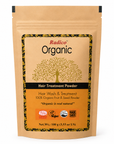
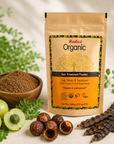
Ayurvedic Hair Treatment Powder - Organic Amla Reetha Shikakai Mix
$9.95
Radico Organic Hair Treatment Powder is three of our single herbs, milled and blended: amla, reetha and shikakai. Nothing else is in the pouch — no fillers, no synthetic preservatives, no fragrance, no PPD, no ammonia.
Net weight 100 g (3.53 oz). It carries no pigment, so it will not dye your hair.
A wash and a mask, from the same pouch
How much water you add decides what this becomes. Thick, it is a treatment you leave on. Thin, it is a wash. The powder is the same either way; only the consistency and the time on the hair change.
The reason it works both ways is a number. Our readings for this blend fall between pH 3.2 and 3.5 — between our two washing herbs, and inside the range cosmetic products designed to be left on the hair are usually formulated to. Shikakai on its own is far more acidic than that, and we do not recommend leaving it on at all.

We measured the pH — and then diluted it
Plant washes are widely described as acidic. We have not found anyone publishing numbers, so we took our own, on a meter calibrated against pH 4.00 and 7.00 buffers before the session. The interesting result was not the figure itself, but what happened when we changed how thick the mix was.
 1:2 - pH3.24
 1:3 - pH3.26
 1:4 - pH3.27
| Mix | Consistency | pH |
|---|---|---|
| 1 : 2 | Thick — the mask | 3.24 |
| 1 : 3 | In between | 3.26 |
| 1 : 4 | Thin — the wash | 3.27 |
Three mixes, one pouch, one session. Between the thickest and the thinnest — a change that drops the powder concentration by a third — the reading moved by 0.03. That is the signature of a buffer, and it has a practical consequence: mixing it thick for a mask does not make it more acidic than mixing it thin for a wash. The fifteen to thirty minutes a mask sits on your scalp is spent at the same pH as the two minutes a wash does.
Across batches the figure moves, between about 3.2 and 3.5. The blend is three milled herbs in the same proportions every time, but growing conditions vary from one harvest to the next and the acid content of a fruit or a pod varies with them. We could hold that number still — it would take a pH adjuster, and there is nothing in this pouch but amla, reetha and shikakai. A figure that never moved would be telling you something had been added to keep it there. The batch we measured: OMP/26/E/001, milled 05/2026.
What acidity does to hair
The outside of a hair is covered in overlapping scales, the cuticle, laid down like tiles on a roof. How flat those scales lie is most of what we perceive as smoothness. Flat scales let a strand slide past its neighbour; lifted scales catch on each other, and hair feels rough and tangles.
Alkaline conditions lift the scales. Acidic conditions let them lie down. That is the whole reason conditioners, acid rinses and every “pH-balanced” claim on a shelf exist — and it is why washing hair with true soap, alkaline at around pH 9, leaves it rough.
You will sometimes read that acidity opens the cuticle so nutrients can get in, and then closes it again. That is the wrong way round. Alkali opens; acid closes. A wash on the acid side is not letting anything in — it is leaving the surface flatter than an alkaline one would.
Foam is not what does the cleaning
Reetha and shikakai clean through saponins — compounds the plant makes that lower the surface tension of water. They lift oil the way any surfactant does, but they produce far less foam than a shampoo.
It is worth separating those two things, because they are not the same property. Lather is what happens when a surfactant traps air. Cleaning is what happens when it surrounds oil. A surfactant can do one well and the other barely at all — which is why industrial and dishwasher detergents are deliberately formulated to foam as little as possible. Foam gets in the way there, so it is engineered out, and the cleaning is unaffected.
This blend does foam more readily than reetha or shikakai do on their own — an observation from mixing all three, not something we have investigated. It is still far less than a conventional shampoo, and that is not a problem.
What is in it
| Herb | What it is doing here |
|---|---|
| ReethaSapindus mukorossi | Saponins. The cleaning. Non-ionic, so it lifts oil without the charge interaction a sulfate has with hair |
| ShikakaiAcacia concinna | Saponins, and most of the acidity. On its own it reads pH 2.1 to 3.0 |
| AmlaEmblica officinalis | The strand — and the one of the three that touches colour |
All three are sold on their own. If you want to understand what each is doing, the single-herb pages go into more detail than we can here.
How to use it
As a treatment — one part powder, two parts water
Mix to a thick yogurt consistency that holds on the brush without dripping, and let it stand 5 minutes; the powder keeps absorbing water after the first stir.
| Hair length | Powder | Warm water |
|---|---|---|
| Short | 15–30 g (½–1 oz) | 30–60 ml (1–2 fl oz) |
| Shoulder length | 30–60 g (1–2 oz) | 60–120 ml (2–4 fl oz) |
| Waist length | 60–100 g (2–3½ oz) | 120–200 ml (4–7 fl oz) |
Why the range is wide. The lower figure covers the hair. The upper figure lets you work more slowly — sectioning properly, getting the paste right to the scalp, taking it through to the ends without stretching it thin. Start at the lower end. You will know within one application whether you would rather have more to work with, and there is no advantage in using more than you need.
- Apply through the lengths, working from the mid-shaft down, then bring what is left up to the scalp.
- Leave on 15 to 30 minutes under a shower cap so the paste stays damp. A dried-out paste stops working — it is the water that keeps the plant compounds in contact with the hair.
- Rinse thoroughly with warm water, head tilted back. Rinse for longer than you think you need to; fine particles settle at the nape and behind the ears.
As a wash — one part powder, four parts water
Mix to a pourable liquid and let it stand 5 minutes. At shoulder length, 10 to 15 g of powder to 40 to 60 ml of water.
- Wet your hair first, then pour the liquid onto the scalp in sections. It will run, so work in parts and tilt your head back to control where it goes.
- Massage the scalp for two to three minutes. Expect a modest amount of foam; it is not a measure of how well it is working.
- Rinse thoroughly, head still tilted back.
Weigh the powder rather than spooning it. A spoonful of milled herb can vary by as much as a third depending on the spoon and how it is scooped, which is why the numbers above are in grams.
What a pouch gives you. Used as a treatment at shoulder length, roughly two to three applications. Used as a wash, seven to ten. Most people use it both ways, so where a pouch lands for you depends on the mix.
Keep it out of your eyes
Saponins are surfactants, and surfactants sting. Being a plant does not make a molecule gentle on the cornea. And because this is milled plant material rather than a dissolved detergent, fine particles can lodge in the eye and keep stinging after the water is gone.
Keep your eyes closed while it is on. If any gets in, flush with plenty of cool running water well past the point it stops hurting — the aim is to carry the particles out, not just dilute the liquid. Do not rub. If irritation persists after a thorough flush, see a doctor.
How often — what we found
You can use this daily. We do not think you need to, and we would rather say so. Using it every day gets through a pouch quickly, so we tested longer intervals to see what was actually necessary.
Washing with it every two to three days, and rinsing with warm water only in between, the slip held for the full two to three days. Hair still ran through the fingers easily on day three.
One condition is worth stating plainly. That was the whole routine — this powder, and warm water on the days in between. No conventional shampoo at any point during the test. We have not tested what happens if you alternate this with a sulfate shampoo, and we would expect a different result: a strong detergent strips more than water does, and a scalp responds to that. What we can tell you is what a water-only routine looked like in our own hands — not what a mixed routine would look like in yours.
If you are coming from daily shampooing, expect a few weeks of adjustment. Scalps washed daily with a strong detergent tend to produce oil at the rate that washing demands, and that rate takes time to settle.
If you colour your hair
Reetha and shikakai carry no pigment, and neither affects a colour result. Amla is different, and it is in here. Amla is naturally acidic, and acidity shifts a henna result cooler and slightly deeper — which is why it is one of the herbs in 23 of Radico’s 24 shades, measured into those recipes deliberately.
Do not use this immediately after colouring. Henna and indigo both keep developing for up to 72 hours after application, and a surfactant wash inside that window will take some of the result with it — more so here, because the amla is working on the tone at the same time. Leave two to three days between colouring and washing with this. After that, it will not strip a herbal colour you already have.
If you want a wash that does nothing at all to the tone, reetha or shikakai on their own are colour-neutral. The trade is the pH: reetha alone reads 4.54 to 4.90 and shikakai alone 2.1 to 3.0, and neither is where you want a treatment you leave on. This blend is the one of the three you can use as a mask.
Why this one is not vacuum sealed
Our colour pouches are vacuum sealed at the point of milling, which is most of the reason they keep for close to five years. This blend is not, and it is worth explaining why, because the shelf life is shorter as a result.
Vacuum sealing this powder compresses it into a solid block. Not a firm cake you can break with a spoon — a block you would need a hammer to get through. We tried it. What comes out is unusable.
So it is packed loose, in a resealable pouch, with a date and an expiry just under three years apart rather than the five a sealed colour pouch gets.
What we do instead. We hold small quantities in the United States and air-freight from India frequently, rather than shipping a container and warehousing it. It costs more per pouch and it is more work. The point is that what reaches you is close to the milling date rather than close to the expiry.
Every pouch is printed with the batch number, the date it was milled and the date it expires, so you can check where in that window yours sits before you open it. The pouch reseals, which also makes it safe to keep in a bathroom.
What we will and will not claim
That saponins are surfactants, and that acidity keeps the cuticle lying flat, are physical chemistry rather than health claims. The pH figures are our own, on a calibrated handheld meter, from mixes made the way we describe here. They are not laboratory certificates, and water hardness will move them. We publish them because they are numbers you can check yourself with an inexpensive meter, and because we have not found anyone else publishing any.
What we have not measured is any outcome. We have not compared cleaning efficiency against a conventional shampoo, and we have not measured combing force. We are not claiming superiority on either count — we would need controlled comparisons to say that honestly.
We are not claiming this powder treats any scalp or hair condition, and in the United States a cosmetic may not make that claim.
Before you use it
Patch test on the inner forearm 48 hours before first use, and stop use if irritation develops. Do not use it on broken or inflamed skin.
Radico Organic Hair Treatment Powder is a cosmetic product for external use on hair and scalp. It is not intended to diagnose, treat, cure or prevent any condition.
All items on Radico USA website ship for a flat-rate to any address in the continental US for just $4.99.
Get free shipping on any order above $25.
If you are unsatisfied with the result, please contact us for a free replacement of the color of your choice. Returns within 30 days receive a full refund.
Ingredients
Three organic herbs, milled and blended — amla (Emblica officinalis), reetha (Sapindus mukorossi) and shikakai (Acacia concinna). Nothing else: no fillers, no synthetic preservatives, no fragrance, no PPD, no ammonia. It carries no pigment, so it will not dye your hair.
100% organic, made in India. Net weight 100 g (3.53 oz). Mixed with water, our own calibrated readings fall between pH 3.2 and 3.5 depending on the batch. Keep out of the eyes. Do not use on broken or inflamed skin. Patch test on the inner forearm 48 hours before first use. This is a cosmetic product for external use on hair and scalp; it is not intended to diagnose, treat, cure or prevent any condition.
FAQ
Our own readings, on a meter calibrated against pH 4.00 and 7.00 buffers, were 3.24 at one part powder to two parts water, 3.26 at 1:3 and 3.27 at 1:4 — all from the same pouch in a single session. Across batches the figure has fallen between about 3.2 and 3.5. Hair's own surface sits at 4.5 to 5.5, and cosmetic products designed to be left on the hair are usually formulated between 3.5 and 4.5.
No, and that is the useful part. Between the thickest mix and the thinnest — a change that drops the powder concentration by a third — the reading moved by 0.03. That is the signature of a buffer, a weak acid sitting alongside its own conjugate base and holding the pH steady against dilution. It means the fifteen to thirty minutes a mask sits on your scalp is spent at the same pH as the two minutes a wash does.
The blend is three milled herbs in the same proportions every time, but growing conditions vary from one harvest to the next and the acid content of a fruit or a pod varies with them. The pH of a pouch reflects the year it was grown in. We could hold that number still, but it would take a pH adjuster, and there is nothing in this pouch but amla, reetha and shikakai. A figure that never moved would be telling you something had been added to keep it there.
As a treatment, 15 to 30 g for short hair, 30 to 60 g at shoulder length, or 60 to 100 g at waist length — mixed with twice its weight in water. The lower figure covers the hair; the upper gives you room to section properly and work slowly. Start at the lower end, because there is no advantage in using more than you need. As a wash, 10 to 15 g covers shoulder-length hair, mixed with four times its weight in water. A pouch gives roughly two to three treatments at shoulder length, or seven to ten washes.
No — leave two to three days. Henna and indigo both keep developing for up to 72 hours after application, and a surfactant wash inside that window will take some of the result with it. It matters more with this blend than with reetha or shikakai alone, because amla is acidic and shifts a henna result cooler, so it is working on the tone at the same time. After 72 hours it will not strip a herbal colour you already have.
Two to three days between washes was enough in our own testing. The slip held for the full two to three days, with warm water rinsing on the days in between and no conventional shampoo at any point. Daily use works too, but it gets through a pouch quickly and we do not think it is necessary. We have not tested alternating this with a sulfate shampoo and would expect a different result.
Because lather and cleaning are separate properties. Lather is what happens when a surfactant traps air; cleaning is what happens when it surrounds oil. Industrial and dishwasher detergents are deliberately formulated to foam as little as possible, and their cleaning is unaffected. This blend does foam more readily than reetha or shikakai do alone, but far less than a conventional shampoo.
Because vacuum sealing compresses this powder into a solid block — not a firm cake you could break with a spoon, but something you would need a hammer to get through. We tried it. So it is packed loose in a resealable pouch, and the shelf life is just under three years rather than the close to five a sealed colour pouch gets. We compensate by holding small quantities in the United States and air-freighting from India frequently, so what reaches you is closer to the milling date than to the expiry. Every pouch is printed with its batch number, milling date and expiry.
No. None of the three herbs carries a dye pigment, so this will not deposit colour. It is not colour-neutral in every sense, though: amla is acidic, and acidity shifts a henna result cooler and slightly deeper. If you have a herbal colour on your hair, that matters most in the 72 hours after application, when the colour is still developing.
- ・100% Pure Plants, No Synthetic Chemicals
- ・Free from Additives, Artificial Fragrance & Harsh Preservatives
- ・Crafted with Traditional Ayurvedic Herbs
We create products rooted in nature and tradition.
Made with certified organic plant ingredients and no synthetic chemicals, our formulas support naturally healthy hair and skin—without compromise.