


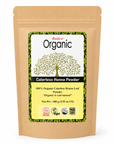
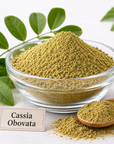
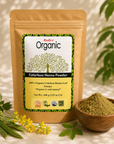
Organic Colorless Henna Leaf Powder For Hair
$9.95
100% Organic Colorless Henna Leaf Powder
Certified Organic Hair Powder — 100g (3.53 oz)
Scientific Name: Cassia obovata
Organic Colorless Henna Leaf Powder is milled Cassia obovata leaf, grown and processed on our own certified organic farms. One ingredient in the pouch and nothing else.
Two different plants are sold as colorless henna, and we use both. This pouch is Cassia obovata. The colorless henna inside our Colour Me Organic shades is Cassia auriculata — same genus, same use, a different species. Supply across the industry shifted from one to the other between roughly 2016 and 2020, and most brands never said so. Everything on this page — the chrysophanol, the pH reading, the caveat about very pale hair — describes C. obovata.
It is called neutral henna not because it is henna, but because it is used in exactly the same way — mixed with warm water, applied as a paste, rinsed out. The two plants are not related and sit in different families. What they share is the kind of molecule that does the work.
One part powder, three parts water
By weight, to a yogurt-thick paste. Of the eight single herbs we make, this is the most ordinary to mix — when we describe another powder as behaving differently at one-to-three, this is the one we are comparing it to. Reetha comes out pourable at that ratio; methi comes out like peanut butter.
Let the paste stand 15 to 20 minutes before applying. The polysaccharides in the leaf need that long to hydrate fully, and the mixture goes from grainy to smooth. This is the step most people skip.
As a starting point: roughly 20 to 30 g of powder for shoulder-length hair, with 60 to 90 ml of warm water. A 100 g pouch gives about three to five applications at that length.
What we measured
We measured the pH of the paste at the consistency we recommend. The reading was 5.12.

Hair's own surface sits at roughly pH 4.5 to 5.5, so this paste lands comfortably inside that range with nothing added to adjust it. Acidic conditions keep cuticle scales lying flat against the shaft — though at 5.12 that is a mild effect rather than the pronounced one you get from a much more acidic powder.
Our own reading, on a handheld meter calibrated against pH 4.00 and 7.00 buffers. Water hardness will move it.
It is why a pale shade can exist
A colorless henna is one of the herbs in 13 of our 24 Colour Me Organic shades — and this is where the two species matter: the shades use Cassia auriculata, not the C. obovata in this pouch. Of the eight herbs we sell on their own, only amla and bhringraj appear in more shades. Look at which thirteen and the reason is plain: every blonde except Honey, three of the four ash tones, all three light reds, Light Brown, and Sun Blonde.
Henna, indigo and manjistha are strongly coloured. To make a blonde you have to dilute them, and the alternative to a colourless plant is a filler that is not a plant. A Cassia is what lets a shade be light and still be made of nothing but certified organic herbs — C. auriculata in the colours, C. obovata in this pouch.
Adding it to a shade yourself works differently from adding a colour-neutral herb. Methi and bhringraj carry no pigment, so a spoonful of either changes nothing you would notice. This one barely colours, which is not the same as not colouring at all — and more to the point, it takes up room in the mix, so every gram lowers the concentration of the herbs that do the colouring. You would also be adding a different species from the one already in the pouch. The result comes out lighter and softer than the shade on the pouch. That can be exactly what you want; it is not something to be surprised by.
Why it behaves like henna without colouring like henna
Both leaves work through quinones — molecules carrying hydroxyl and carbonyl groups that form hydrogen bonds with keratin's polar side chains. That is why both are used as a water paste left on the hair.
The difference is which quinone dominates, and how strongly it absorbs light. True henna carries lawsone, one of the most intensely coloured plant dyes there is. Cassia obovata carries little to no lawsone; its dominant constituents are anthraquinones — chrysophanol above all — which are only weakly pigmented at the concentrations and contact times used on hair.
Same kind of interaction with keratin. Almost none of the colour.
⚠️ The honest version is not "no colour"
Chrysophanol is described in the chemical literature as appearing in golden yellow plates. It is a dye. What it is not is a strong one — so little deposits that on brown, black, red or grey hair there is nothing to see at all.
On white, platinum or very pale blonde hair, a long application can leave a faint golden or straw-toned cast. If your hair is in that range, strand test first and start at 20 minutes rather than 60. The compound explains the exception rather than contradicting it — and we would rather say near-neutral than colourless.
It is not a protein treatment
Conventional strengthening masks work by depositing hydrolysed protein — keratin, wheat, silk, rice. Some hair, particularly low-porosity hair, responds badly to that and goes stiff and straw-like.
There is no added protein in this powder at all. That is a statement about the ingredient list rather than a claim about outcomes — and for people who have found protein masks unsuitable, it is the useful fact here.
⚖️ What we do not claim
Chrysophanol, emodin and aloe-emodin have all been reviewed in the pharmacological literature, and antimicrobial and anti-inflammatory activity is described there. That work concerns isolated compounds in laboratory conditions — not milled whole leaf, in a water paste, on a human scalp, at the concentrations involved here.
We are not claiming this powder treats dandruff, flaking, scalp inflammation, or any other condition. In the United States a cosmetic may not make that claim. What we can tell you is what is in the pouch, that the anthraquinones are only weakly pigmented, where the paste sits on a pH meter, and that Cassia obovata has been used this way across Ayurvedic and North African traditions for a very long time.
People do report that hair feels denser and smoother afterwards, and so do we. We have not run tests on strand diameter, porosity or combing force, and we would need to before claiming any of them.
Check the ingredient list — on any brand
Some products marketed as "neutral henna" contain added synthetic dyes or PPD. A genuine one names its plant and lists nothing else. Either Cassia obovata or Cassia auriculata is a real answer — both are sold under the name and both are only weakly pigmented. What is worth questioning is a pouch that gives no botanical name at all, or a colourless product that produces a definite colour.
This applies to us as much as to anyone. This pouch says Cassia obovata, our hair colours say Cassia auriculata, and each is what is in it.
All items on Radico USA website ship for a flat-rate to any address in the continental US for just $4.99.
Get free shipping on any order above $25.
If you are unsatisfied with the result, please contact us for a free replacement of the color of your choice. Returns within 30 days receive a full refund.
Ingredients
This product contains 100% Organic Colorless Henna Leaf Powder — nothing else. A single-ingredient hair mask milled from organically certified Cassia obovata leaf. Free from additives, chemicals and synthetic ingredients, and with no added protein of any kind. It is called neutral henna because it is used the same way as henna, not because it is henna — the two plants are unrelated. Note also that two different plants are sold as colorless henna: this pouch is Cassia obovata, while the colorless henna inside our Colour Me Organic shades is Cassia auriculata, a separate species.
100% Organic. Made in India. Near-neutral rather than colourless: chrysophanol, the principal compound in this leaf, is a weakly pigmented golden-yellow anthraquinone, so on white, platinum or very pale blonde hair a long application may leave a faint golden cast. Strand test if your hair is in that range. Always perform a patch test on the inner forearm 48 hours before full application.
FAQ
No. Cassia obovata and Lawsonia inermis are unrelated plants in different families. The name comes from the fact that it is used in exactly the same way — mixed with water, applied as a paste, rinsed out. Both work through quinones that associate with keratin; henna's is intensely coloured, and this one's is not.
On brown, black, red or grey hair, no. Chrysophanol, the principal compound in this leaf, is a golden-yellow substance but a very weak dye, so almost nothing deposits. On white, platinum or very pale blonde hair a long application can leave a faint golden cast — strand test first and start at 20 minutes if your hair is in that range.
Yes. It deposits no meaningful pigment, so it will not shift a salon colour or interfere with future services. Wait 72 hours after any fresh colour before using it.
We do not make that claim. The anthraquinones in this leaf have been studied as isolated compounds in laboratory conditions, but that is not the same as milled whole leaf in a water paste on a human scalp, and in the United States a cosmetic may not claim to treat a scalp condition. Persistent flaking or inflammation should be looked at by a dermatologist.
It probably has not stood long enough. Mix at one part powder to three parts water and let it rest 15 to 20 minutes before applying — the leaf polysaccharides hydrate in that window and the paste becomes noticeably smoother.
Yes. A colorless henna is already in 13 of our 24 shades — though that is Cassia auriculata, a different species from the C. obovata in this pouch. Both work the same way here: it adds almost no pigment of its own, yet it takes up room in the mix, so it lowers the concentration of the herbs that do the colouring. The result comes out lighter and softer than the shade on the pouch.
No. There is no added protein in this powder at all. Conventional strengthening masks deposit hydrolysed protein, which some hair — particularly low-porosity hair — responds badly to. If protein masks have left your hair stiff, that absence is the useful fact here.
Every two to four weeks. Nothing needs to accumulate on a schedule — use it when your hair wants it.
- ・100% Pure Plants, No Synthetic Chemicals
- ・Free from Additives, Artificial Fragrance & Harsh Preservatives
- ・Crafted with Traditional Ayurvedic Herbs
We create products rooted in nature and tradition.
Made with certified organic plant ingredients and no synthetic chemicals, our formulas support naturally healthy hair and skin—without compromise.
Freshness
Sealed Airtight, Ordered Little and Often
Airtight, not vacuum
So the powder stays loose
Some herb powders pack into a hard block under vacuum, and customers asked us to stop. These pouches are sealed airtight with the air left in.
3 years
Unopened, from manufacture
Without the vacuum, we set a shorter limit than our hair colours. The batch number, manufacture date and expiry date are printed on every pouch.
Ordered small
Little time on our shelves
We order single herbs in the smallest amounts we can, so each pouch spends as little time as possible waiting to be sent.
12 months+
Left on every pouch we send
We ship the oldest stock first, and take any batch with less than 12 months left out of sale.
Once opened, press the air out, reseal tightly and keep it dry. Applies to orders shipped by Radico USA. More on freshness →