


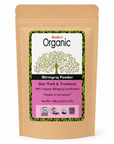
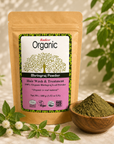
Organic Bhringraj Leaf Powder For Hair
$9.95
What this is
Radico Organic Bhringraj Leaf Powder is a single-ingredient scalp and root treatment made from 100% Eclipta prostrata (syn. E. alba) leaf, grown and milled on Radico’s own certified organic farms in India. There is one ingredient in the pouch and nothing else — no fillers, no synthetic preservatives, no fragrance, no PPD, no ammonia. It is certified by ECOCERT COSMOS, MADE SAFE, and the Vegan Trademark.
Net weight 100 g (3.5 oz). Enough for 13 to 20 scalp treatments on short to shoulder-length hair, or about 3 full-length masks at shoulder length.
Does bhringraj colour hair? No.
Bhringraj contains no lawsone — the pigment that makes henna deposit copper-red — and no indigotin, the pigment in indigo. Radico Organic Bhringraj Leaf Powder will not dye your hair, will not cover gray, and will not shift the tone of a herbal colour you already have.
Traditional Ayurvedic texts describe bhringraj as darkening hair over long use, and you will find that claim repeated across the internet. We are not able to support it. There is no pigment in the leaf to deposit, so this is not a question of how many applications you do — one or fifty, there is nothing in the pouch that colours. If you want colour you need henna, indigo, or one of Radico’s 24 pre-blended shades. Bhringraj is a care herb, not a colour herb.
What is actually in it
The principal compound in Eclipta prostrata leaf is wedelolactone, a coumestan. The leaf also contains demethylwedelolactone, luteolin, apigenin, β-amyrin, and plant sterols.
Laboratory work on wedelolactone is preclinical, and uses concentrated extracts rather than milled leaf. It does not establish that applying this powder to a human scalp produces hair growth, and we are not going to imply that it does. Bhringraj is in this range on the strength of long documented use in Ayurvedic hair preparations — described in both the Charaka Samhita and the Sushruta Samhita — and that is the honest basis for it.
Radico adds nothing to this powder. The only ingredient is the milled leaf, so what reaches your scalp is what grew on the plant.
Some listings state that bhringraj powder contains vitamins A and D. We do not make that claim, because we have not found it supported in the peer-reviewed phytochemical literature on this species.
Which Radico herb should you choose?
| If your concern is | Choose |
|---|---|
| Thinning, weak or tired-feeling hair — care at the root | Bhringraj (Eclipta prostrata, syn. E. alba) |
| An itchy or sensitive scalp | Brahmi (Bacopa monnieri) |
| A flaking or tight-feeling scalp | Neem (Azadirachta indica) |
| Dry or brittle strands | Methi (Trigonella foenum-graecum) |
| Dullness — and softening henna’s warmth | Amla (Phyllanthus emblica, syn. Emblica officinalis) |
Of the herbs Radico makes for the scalp, bhringraj is the one Ayurveda names specifically for hair — Kesharaja, king of hair. Of these five, only amla changes a colour result through its own chemistry: it is acidic, and acidity shifts how henna releases its pigment. The other four add no colour of their own.
How to use it
Bhringraj is a scalp herb first. Most people use it on the roots and scalp only, which takes far less powder than a full-length mask.

1. Weigh the powder
We list weights rather than spoonfuls, because a spoonful of leaf powder can vary by a third depending on the spoon and how it is scooped. A small kitchen scale takes the guesswork out.
For the scalp and roots only
| Short to shoulder length | 5–8 g (about ¼ oz) |
|---|---|
| Long or very thick | 10–16 g (⅓–½ oz) |
For a full-length mask
| Short / chin length | 15–20 g (½–¾ oz) |
|---|---|
| Shoulder length | 30 g (1 oz) |
| Long or very thick | 50–60 g (1¾–2 oz) |
2. Mix with warm water
Add warm water gradually — roughly three times the powder’s weight in millilitres — until the paste reaches a thick yogurt consistency. It should hold on the brush without dripping. Let it stand 5 minutes and check again, as the powder keeps absorbing water.
| Powder | Warm water |
|---|---|
| 5–8 g (¼ oz) | 15–25 ml (½–1 fl oz) |
| 10–16 g (⅓–½ oz) | 30–50 ml (1–1¾ fl oz) |
| 15–20 g (½–¾ oz) | 45–65 ml (1½–2¼ fl oz) |
| 30 g (1 oz) | 90–115 ml (3–4 fl oz) |
| 50–60 g (1¾–2 oz) | 150–200 ml (5–7 fl oz) |
3. Apply to the scalp first
Section the hair and work the paste into the scalp with your fingertips, then draw the rest down through the lengths.
4. Leave on 30–45 minutes
Cover with a shower cap so the paste stays damp. A dried-out paste has stopped doing anything — it is the moisture that keeps the plant material in contact with the scalp. We have no reason to think longer than 60 minutes changes the outcome, and we have not tested past that.
5. Rinse
Rinse thoroughly with warm water — powder masks hide at the nape. Shampoo is optional.
How often: once to three times a week, as suits your routine. Because there is no pigment in it, repeating it will not gradually darken your hair the way a plant dye would. How often you use it is a matter of what your routine allows rather than a limit we can point to.
Can I mix it with henna or a Radico shade?
Yes. Bhringraj carries no pigment of its own, so it will not add colour to a mix, will not shift the tone, and will not improve gray coverage. Blend the dry powders together before adding water so it distributes evenly.
One thing to keep in proportion, though. Any powder you add takes up room in the pouch. A spoonful into a full application makes no practical difference. Add a large share and you are lowering the concentration of the herbs that do the colouring, and the result will come out lighter — not because bhringraj did anything to the colour, but because there is less colouring herb per gram. The same is true of methi and brahmi. Colorless henna is the extreme case: dilution is the whole reason it is in a blend at all.
In fact, you have probably used bhringraj already: it is one of the herbs in 22 of Radico’s 24 shades — every one except Violet and Honey Blonde. Only amla appears in more, at 23. It is in those pouches as a scalp herb, on the same traditional basis as this one, and not as a dye.
What we have not measured: whether adding bhringraj to a colour changes how long the colour takes to develop. We would expect an inert powder to leave that alone, but we have not tested it, so we are not going to tell you either way.
Before you use it
Eclipta prostrata belongs to the Asteraceae family, alongside ragweed, chrysanthemum, marigold and daisy. If you have a known Asteraceae allergy, patch test on your inner forearm 48 hours before use, or choose Radico Brahmi Leaf Powder instead — Brahmi is in the unrelated Plantaginaceae family.
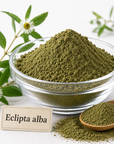
On the name. You will see this plant listed as Eclipta alba at least as often as Eclipta prostrata, including on most of the published research. They are the same plant. Eclipta prostrata (L.) L. is the currently accepted name at Kew’s Plants of the World Online; Eclipta alba (L.) Hassk. is a synonym of it. We print the accepted name and the synonym together so that a label, a supplier document and a search result all lead to the same place.
Radico Organic Bhringraj Leaf Powder is a cosmetic product for external use on hair and scalp. It is not intended to diagnose, treat, cure, or prevent any condition, including hair loss.
All items on Radico USA website ship for a flat-rate to any address in the continental US for just $4.99.
Get free shipping on any order above $25.
If you are unsatisfied with the result, please contact us for a free replacement of the color of your choice. Returns within 30 days receive a full refund.
Ingredients
This product contains 100% Organic Bhringraj Leaf Powder — nothing else. A single-ingredient Ayurvedic scalp and root treatment, milled from organically certified Eclipta prostrata (syn. E. alba) leaf. No fillers, no synthetic preservatives, no fragrance, no PPD, no ammonia. It carries no lawsone and no indigotin, so it does not dye hair or cover gray.
100% organic, made in India. Net weight 100 g (3.5 oz). Patch test on the inner forearm 48 hours before a full application. Eclipta prostrata (syn. E. alba) belongs to the Asteraceae family, alongside ragweed, chrysanthemum, marigold and daisy — worth knowing if you react to any of those. This is a cosmetic product for external use on hair and scalp; it is not intended to diagnose, treat, cure or prevent any condition.
FAQ
No. Bhringraj contains no lawsone, the pigment in henna, and no indigotin, the pigment in indigo. It will not colour your hair, will not cover gray, and will not shift the tone of a herbal colour you already have. Traditional Ayurvedic texts describe bhringraj as darkening hair over long-term use, but that is a description of a traditional practice, not of a dye: there is no pigment in the leaf to deposit, so this is not a question of how many applications you do.
It is a scalp and root treatment. Bhringraj is the herb Ayurveda names specifically for hair — kesharaja, king of the hair — and it is applied to the skin at the roots rather than drawn through the lengths. Most people use it on the scalp only, which takes a fraction of the powder a full-length mask would.
For a scalp treatment, 5 to 8 g (about ¼ oz) for short to shoulder-length hair, or 10 to 16 g (⅓ to ½ oz) for long or very thick hair. For a full-length mask, 30 g (1 oz) covers shoulder-length hair from scalp to ends. Weigh rather than spoon: a spoonful of leaf powder can vary by a third depending on how it is scooped.
Between 13 and 20 scalp treatments for short to shoulder-length hair, or about 3 full-length masks at shoulder length.
30 to 45 minutes, kept damp under a shower cap. A dried-out paste stops working, because it is the water that keeps the plant compounds in contact with the scalp. We have not found an advantage to leaving it longer than 60 minutes.
Yes. Because bhringraj carries no pigment of its own, it can be blended into henna, indigo or any Radico shade without adding colour or shifting the tone. Bear in mind that any powder you add takes up room: a spoonful makes no practical difference, but a large share lowers the concentration of the herbs that do the colouring, and the result comes out lighter. In fact you have probably used it already: bhringraj is one of the herbs in 22 of Radico's 24 shades. What it will not do in a mix is darken the result or improve gray coverage. Whether it changes how long a colour takes to develop, we have not measured.
Eclipta prostrata (syn. E. alba) belongs to the Asteraceae family, alongside ragweed, chrysanthemum, marigold and daisy. If you have a known Asteraceae allergy, patch test on the inner forearm 48 hours before a full application, or choose Radico Brahmi Leaf Powder instead — Brahmi is in the unrelated Plantaginaceae family. We cannot tell you whether any plant is safe for you; we can tell you what is in the pouch.
- ・100% Pure Plants, No Synthetic Chemicals
- ・Free from Additives, Artificial Fragrance & Harsh Preservatives
- ・Crafted with Traditional Ayurvedic Herbs
We create products rooted in nature and tradition.
Made with certified organic plant ingredients and no synthetic chemicals, our formulas support naturally healthy hair and skin—without compromise.
Freshness
Sealed Airtight, Ordered Little and Often
Airtight, not vacuum
So the powder stays loose
Some herb powders pack into a hard block under vacuum, and customers asked us to stop. These pouches are sealed airtight with the air left in.
3 years
Unopened, from manufacture
Without the vacuum, we set a shorter limit than our hair colours. The batch number, manufacture date and expiry date are printed on every pouch.
Ordered small
Little time on our shelves
We order single herbs in the smallest amounts we can, so each pouch spends as little time as possible waiting to be sent.
12 months+
Left on every pouch we send
We ship the oldest stock first, and take any batch with less than 12 months left out of sale.
Once opened, press the air out, reseal tightly and keep it dry. Applies to orders shipped by Radico USA. More on freshness →