


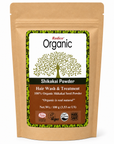
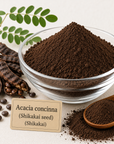
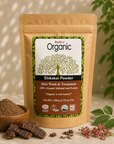
Organic Shikakai Seed Powder For Hair
$9.95
Radico Organic Shikakai Powder is milled Acacia concinna — the dried pod and the seed inside it, ground together — grown on our own certified organic farms. One ingredient in the pouch and nothing else: no fillers, no synthetic preservatives, no fragrance, no PPD, no ammonia.
Net weight 100 g (3.5 oz). Roughly seven to ten washes at shoulder length. It carries no pigment, so it will not colour hair or shift a herbal colour you already have.
It washes like reetha. It leaves the hair different.
Radico makes two herbs for washing, and they are not interchangeable. Both clean through saponins, and both produce far less foam than a shampoo. What separates shikakai is what the hair feels like afterwards — and the reason is measurable.
Its name says as much, and it is Tamil rather than Sanskrit: shikai for the tresses, kai for the fruit — the fruit for the hair. In Sanskrit the plant goes by a different name entirely, saptala. It has been the washing herb of Ayurvedic hair care rather than a general-purpose cleanser.
We measured the pH
Shikakai is widely described as acidic. We have not found anyone publishing a number, so we took one — on a meter calibrated against pH 4.00 and 7.00 buffers before the session.
| Reetha | Shikakai | |
|---|---|---|
| Mixed at 1:3 by weight | pH 4.54 to 4.90 | pH 2.1 to 3.0 |
| Diluted to 1:6 | Rose to 5.04 | No change |
The readings are given as ranges because this is a suspension of milled plant material, not a clear solution — the probe reads whatever happens to be against it. The dilution result is the interesting one. An unbuffered acid would have risen by around 0.3 on doubling the water. Reetha rose by 0.14; shikakai did not move at all. That is the signature of a buffer, and it has a practical consequence: making the mix weaker does not make it less acidic.
What acidity does to hair
The outside of a hair is covered in overlapping scales, the cuticle, laid down like tiles on a roof. How flat those scales lie is most of what we perceive as smoothness. Flat scales let a strand slide past its neighbour; lifted scales catch on each other, and hair feels rough and tangles.
Alkaline conditions lift the scales. Acidic conditions let them lie down. That is the whole reason conditioners, acid rinses and every “pH-balanced” claim on a shelf exist — and it is why washing hair with true soap, alkaline at around pH 9, leaves it rough.
Shikakai does its cleaning at the opposite end of that scale. The wash and the smoothing are not two steps here; they are the same step.
What we notice. Hair comes out of a shikakai wash easier to comb through than we expect it to, and more so than after reetha. We are reporting that as an observation rather than a measurement — combing force can be measured properly and we have not done it. What we can say is that the pH readings give a reason to expect the difference.
What is actually in it
Shikakai cleans through triterpenoid saponins: molecules with a waxy, oil-loving core and a water-loving chain of sugars. That architecture is what every soap and shampoo uses, and it is why a plant can wash hair at all.
| Compound | Identifiers |
|---|---|
| Concinnoside B | C43H67NO13 · 806.0 g/mol · PubChem SID 275754598 |
Its sugar chain includes an amino sugar — an N-acetyl group, which is why the formula carries a nitrogen that most saponins do not. The same structure appears in PubChem’s compound records as acaciamine, reported from other Acacia species; that is a naming difference rather than a different molecule.
We do not list vitamin or antioxidant content for this powder. Figures of that kind come from nutritional analysis and describe what a plant does when eaten. We have not found work establishing what they do on a scalp as a rinsed-off wash.
How to use it
Shikakai is a wash, not a mask. You mix it to a pourable liquid, work it through the scalp for a couple of minutes, and rinse it out.
1. Mix one part powder to three parts water
By weight. Stir into warm water and let it stand 5 minutes — the saponins need a moment to come out of the plant material.
At 1:3 this is a liquid, not a paste. That is what you want for something you are going to wash with: a paste would sit on the hair; a liquid runs through it and reaches the scalp.
| Hair length | Powder | Warm water |
|---|---|---|
| Short to chin | 8–10 g (¼–⅓ oz) | 25–30 ml (1 fl oz) |
| Shoulder length | 10–15 g (⅓–½ oz) | 30–45 ml (1–1½ fl oz) |
| Long or very thick | 20–25 g (¾ oz) | 60–75 ml (2–2½ fl oz) |
Weigh the powder rather than spooning it — a spoonful of milled pod can vary by as much as a third depending on the spoon and how it is scooped.
2. Wet your hair first
Shikakai works on wet hair, the same as any wash.
3. Pour it onto the scalp in sections
Not all in one place. It is thin, so it will run — work in parts and tilt your head back to control where it goes.
4. Massage for two to three minutes
With your fingertips, at the scalp. This is where the cleaning happens. Expect very little foam; that is normal and is not a sign it is not working.
5. Rinse thoroughly, head tilted back
Rinse for longer than you think you need to. This is milled pod and seed, and fine particles settle at the nape and behind the ears.
Three things the pH reading tells you
- Do not leave it on. Two to three minutes, then rinse. At around pH 2 this is not something to sit on the scalp while you do something else, and it is not a pre-wash mask.
- Diluting will not soften it. The pH holds steady on dilution. If you want a milder wash, use less powder or less time instead.
- Keep it out of your eyes, and off broken or inflamed skin. Saponins sting; undissolved particles can lodge in the eye and keep stinging after rinsing; and the acidity does not help either. If any gets in, flush with plenty of cool running water well past the point it stops hurting, and do not rub. If irritation persists, see a doctor.
Being a plant does not make a number gentle. What makes shikakai reasonable to wash with is how briefly it is on the hair, not that it grew on a tree.
How often: two to three times a week suits most people. Most people find they reach for it less often than a sulfate shampoo. We have not compared cleaning efficiency in any controlled way, so that is what we hear rather than something we have measured.
If you are coming from a sulfate shampoo, expect a few weeks of adjustment. People switching to a plant wash commonly report an oilier period before things settle, and we hear it often enough to mention. Whether daily detergent washing actually changes how much oil a scalp produces is not something we can point you to good evidence for — but the adjustment period itself is real enough in what customers tell us.
Using it with reetha
The two were traditionally used together as often as separately. Blend the dry powders first, then add water at the same one-to-three ratio. Equal parts is a reasonable starting point: more reetha gives a cleaner, more neutral wash; more shikakai gives a more acidic one and, in our hands, a smoother result to comb through.
A blend will land somewhere between the two readings we took. We have not measured where — that is us reasoning from two numbers rather than reporting a third.
Do not add oil to the wash. Coconut oil and shikakai are sometimes recommended together, but oil and surfactant work against each other: the saponins spend themselves lifting the oil you added rather than the oil already on your scalp. If you want an oil treatment, do it before, and wash it out with shikakai afterwards.
Shikakai and colour
Shikakai is in 1 of Radico’s 24 shades — Sun Blonde alone, the same as reetha. Only neem appears in fewer — it is in none of them. That makes sense: this is a cleanser rather than a colour or conditioning herb. It carries no pigment, so washing with it will not shift a herbal colour you already have.
One thing worth timing. Do not wash with shikakai immediately after a plant colour. Henna and indigo both keep developing for up to 72 hours after application, and a surfactant wash inside that window will take some of the result with it. Give it two to three days. This matters more with shikakai than with reetha, because the acidity is working on the cuticle at the same time the colour is still binding to it.
Which Radico herb should you choose?
| If your concern is | Choose |
|---|---|
| Washing and softening in one step | Shikakai (Acacia concinna) |
| A wash with nothing added | Reetha (Sapindus mukorossi) |
| A flaking or tight-feeling scalp | Neem (Azadirachta indica) |
| Thinning, weak or tired-feeling hair | Bhringraj (Eclipta prostrata, syn. E. alba) |
| Dry or brittle strands | Methi (Trigonella foenum-graecum) |
What we will and will not claim
That saponins are surfactants, and that acidity keeps the cuticle lying flat, are physical chemistry rather than health claims. The pH figures are our own, on a calibrated handheld meter, from mixes made the way we describe here. They are not laboratory certificates, and water hardness will move them.
What we have not measured is any outcome. We have not compared cleaning efficiency against a shampoo, and we have not measured combing force against reetha or anything else. We are not claiming superiority on either count — we would need controlled comparisons to say that honestly.
Published work on Acacia concinna covers a range of biological activity, most of it concerning extracts in laboratory conditions rather than milled pod on a human scalp. We are not claiming this powder treats any scalp condition, and in the United States a cosmetic may not make that claim.
Before you use it
Acacia concinna — the accepted botanical name is now Senegalia rugata — belongs to the Fabaceae family, the legume family. Patch test on the inner forearm 48 hours before first use, and stop use if irritation develops.
Radico Organic Shikakai Powder is a cosmetic product for external use on hair and scalp. It is not intended to diagnose, treat, cure or prevent any condition.
All items on Radico USA website ship for a flat-rate to any address in the continental US for just $4.99.
Get free shipping on any order above $25.
If you are unsatisfied with the result, please contact us for a free replacement of the color of your choice. Returns within 30 days receive a full refund.
Ingredients
This product contains 100% Organic Shikakai Powder — nothing else. A single-ingredient wash, milled from organically certified Acacia concinna (accepted name Senegalia rugata): the dried pod and the seed inside it, ground together. No fillers, no synthetic preservatives, no fragrance, no PPD, no ammonia. It carries no pigment, so it does not colour hair.
100% organic, made in India. Net weight 100 g (3.5 oz). Mixed at one part powder to three parts water, our own calibrated readings fell between pH 2.1 and 3.0 — strongly acidic. Use it as a wash and rinse it out within two to three minutes; do not leave it on, and do not use it on broken or inflamed skin. Keep out of the eyes. Patch test on the inner forearm 48 hours before first use. This is a cosmetic product for external use on hair and scalp; it is not intended to diagnose, treat, cure or prevent any condition.
FAQ
Our own readings, on a meter calibrated against pH 4.00 and 7.00 buffers, fell between 2.1 and 3.0 for a mix of one part powder to three parts water by weight. We give a range because this is a suspension of milled plant material rather than a clear solution, so the probe reads whatever happens to be against it. For comparison, our reetha measured between 4.54 and 4.90 under the same conditions.
No, and this surprised us. We diluted a mix from one part powder in three parts water to one part in six — half the concentration — and the pH did not move at all. That is the signature of a buffer, a weak acid sitting alongside its own conjugate base and holding the pH steady against dilution. Reetha, tested the same way, rose only 0.14 where an unbuffered acid would have risen around 0.3. If you want a milder wash, use less powder or leave it on for less time; adding water will not do it.
The outside of a hair is covered in overlapping cuticle scales, and how flat they lie is most of what we perceive as smoothness. Alkaline conditions lift the scales; acidic conditions let them lie down, which is why conditioners and acid rinses are formulated on the acid side. Shikakai does its cleaning at the acidic end of that scale, so the wash and the smoothing are the same step. We have not measured combing force and are not claiming superiority — what we can say is that the pH readings give a reason to expect the difference.
No. Shikakai is a wash: two to three minutes on the scalp and then rinse. Our readings put the mix between pH 2.1 and 3.0, which is strongly acidic — the region of lemon juice — and hair's own surface sits at 4.5 to 5.5. It has been used this way for a very long time, but what makes it reasonable is how briefly it is on the hair. It is also not a good idea on broken or inflamed skin.
We would not recommend adding oil to the wash. Oil and surfactant work against each other: the saponins spend themselves lifting the oil you added rather than the oil already on your scalp. If you want an oil treatment, do it before, and wash it out with shikakai afterwards.
One part powder to three parts water by weight. For short to chin-length hair, 8 to 10 g of powder to 25 to 30 ml of water; for shoulder length, 10 to 15 g to 30 to 45 ml; for long or very thick hair, 20 to 25 g to 60 to 75 ml. A 100 g pouch gives roughly seven to ten washes at shoulder length. Weigh rather than spoon, as a spoonful of milled pod can vary by a third.
Both clean through saponins and both produce very little foam. Reetha is a wash and nothing else; shikakai is markedly more acidic, and hair comes out of it easier to comb through. Neither is a stronger cleanser than the other in any way we have measured — the difference is in what is left behind rather than how much is taken away. They can also be used together: blend the dry powders and add water at the same one-to-three ratio.
Yes. Saponins are surfactants and surfactants sting, and shikakai has two additional problems a liquid detergent does not: it is milled plant material, so undissolved particles can lodge in the eye and keep stinging after the water is gone, and the mix is strongly acidic. Tilt your head back throughout, keep your eyes closed while the wash is on, and if any gets in, flush with plenty of cool running water well past the point it stops hurting. Do not rub. If irritation persists, see a doctor.
- ・100% Pure Plants, No Synthetic Chemicals
- ・Free from Additives, Artificial Fragrance & Harsh Preservatives
- ・Crafted with Traditional Ayurvedic Herbs
We create products rooted in nature and tradition.
Made with certified organic plant ingredients and no synthetic chemicals, our formulas support naturally healthy hair and skin—without compromise.
Freshness
Sealed Airtight, Ordered Little and Often
Airtight, not vacuum
So the powder stays loose
Some herb powders pack into a hard block under vacuum, and customers asked us to stop. These pouches are sealed airtight with the air left in.
3 years
Unopened, from manufacture
Without the vacuum, we set a shorter limit than our hair colours. The batch number, manufacture date and expiry date are printed on every pouch.
Ordered small
Little time on our shelves
We order single herbs in the smallest amounts we can, so each pouch spends as little time as possible waiting to be sent.
12 months+
Left on every pouch we send
We ship the oldest stock first, and take any batch with less than 12 months left out of sale.
Once opened, press the air out, reseal tightly and keep it dry. Applies to orders shipped by Radico USA. More on freshness →